


Purna Swaraj
India’s Republic Day, January 26, 1950, was a joyous moment when Indian citizens finally attained fundamental rights. They were no longer slaves, but the citizens of a free country.
The Indian National Congress (INC) played a significant role in India’s freedom struggle against British colonial rule. It was a major turning point when the INC passed the historic ‘Purna Swaraj’ (total independence) resolution in December 1929 during its Lahore session. And, in the following year on January 26, 1930, Purna Swaraj was announced publicly. It was a pledge declaring India’s independence, which was celebrated as Independence Day by the INC. The resolution was a response to Viceroy Irwin’s inability to grant dominion status for India.
The Purna Swaraj resolution was a defining moment made possible by the collective efforts of many freedom fighters and especially by Mahatma Gandhi’s mass mobilisation. But real independence meant transfer of power (from the British to India), which was finally achieved 17 years later in August 1947. As a result, January 26 came to be recognised not as Independence Day, but as Republic Day. It was the day, in the year 1950, that India got its constitution and the sovereign and democratic Indian state came into existence.
India and Its Constitution
Post-independence, national leaders faced the difficult task of uniting India’s many regions, classes and communities into a single nation. When Jawaharlal Nehru became the first prime minister in 1947, perfecting the constitution became a priority as this effort had already started in 1946. Mahatma Gandhi’s assassination in 1948 halted the process of drafting a written constitution.

Longest Written Constitution
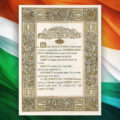
Drafting the Indian Constitution took almost three years (approximately 2 years, 11 months, and 18 days). It is the longest written constitution in the world, reflecting the diversity of our democratic country. The original script was handwritten by renowned calligrapher Prem Narayan Raizada. It goes without saying that Dr BR Ambedkar was the chief architect of the Indian Constitution. He served as the chairman of the Drafting Committee and worked with six other members to prepare the constitution document. The document consists of the framework that establishes the fundamental political code, structure and procedures, powers and duties of India’s government institutions and the fundamental rights and duties of Indian citizens. The core idea was that the country should operate with fairness and justice and there should be no misuse of power by the judiciary, citizens or the government.
The original Constitution of India includes beautiful art inspired by India’s cultural heritage, covering 5,000 years of Indian history till the freedom movement and mythological, spiritual, regional and physical landscape too. It has gorgeous hand-painted illustrations with each page consisting of a gold leaf frame. Many renowned artists, painters and calligraphers were involved in the process of designing and decorating India’s Constitution.

The First Republic Day Celebrations
India’s first president, Dr Rajendra Prasad took oath in the Durbar Hall at the Government House (now Rashtrapati Bhavan) in the capital New Delhi on January 26, 1950, to celebrate India’s first Republic Day. This was followed by the swearing-in of the prime minister and his council of ministers. Likewise, governors, chief ministers and their cabinet colleagues took oath in the newly-formed states of the Indian republic. In the afternoon, the president drove to Irwin Amphitheatre (now Dhyanchand Stadium) and met the chiefs of the Indian army, navy and air force. He then hoisted the Indian national flag and bands played the national anthem.
The Republic Day Parade was designed as an annual tradition since January 26, 1951, and became a large ceremonial event with a grand route. The parade became a key ritual to celebrate the occasion with its route, timing, music and marching groups planned strategically. It is believed that the key elements were designed by Jawaharlal Nehru to impress global audiences with India’s cultural diversity and richness, while also leaving a lasting impression on Indian citizens.
Various art exhibitions, cultural activities, music and dance festivals and literary and sports events were organised prior to the parade to emphasise that India’s cultural progress was as important as that of its military.
The parade at Rajpath (now Kartvyapath) was also symbolic of ‘unity in diversity’. The event is concluded with the Beating Retreat ceremony on January 29, three days after Republic Day. This ceremony honours the courage and sacrifice of India’s armed forces and is led by the supreme commander of the armed forces, the president of India. As a part of this event, music is played by the bands of the Indian army, navy and air force, Delhi Police and the Central Armed Police Forces.
Although the Republic Day event has changed over the years, it still preserves its basic essence, traditional spirit and modern outlook while celebrating India’s cultural heritage. The Ministry of Defence is the authority responsible for organising the parade and its related celebrations.
Ekees Topo Ki Salaami
The 21-gun (ekees top) salute, a ritual inherited from the British Empire, has become an important part of Republic Day celebrations. Historically, it signified the unloading of weapons as a gesture of peaceful intent. Over time, it has evolved into a ceremonial honour. On Republic Day, the salute is rendered by firing artillery to honour the national flag and the president of India, who is the commander-in-chief of the Indian Armed Forces.
DID YOU KNOW?
The light field gun used for the 21-gun salute was manufactured by the Indian Ordnance Factory in 1982 and is about 1,000kgs lighter than the standard Indian field gun. During the ceremony, seven artillery guns fire three rounds each using a special ceremonial cartridge, with an interval of about 2.25 seconds between shots, matching the 52-second duration of the Indian national anthem—Jana Gana Mana.
India’s Transformation
Decades after India’s first Republic Day celebration, we can analyse the freedom struggle, but it is difficult to truly feel its emotions and the pain involved. From a newly formed sovereign republic to a global power, India’s transformation has been remarkable.
The vision of India’s national leaders was clearly reflected in the Constitution of India when it was first adopted. A parliamentary system was established that provided guidance and direction for a stable and accountable government. An independent judiciary was also created to ensure justice, protect fundamental rights, uphold equality and safeguard the interests of citizens, while maintaining an unbiased approach despite cultural, regional and other differences within the country.

The Challenging Years of Nation-building (1950 to 1970)
Prime Minister Jawaharlal Nehru was a staunch supporter of self-sufficiency, just like Mahatma Gandhi. To encourage economic resilience and reduce dependence on imports, the First Five-Year Plan of 1951 emphasised the role of the state in driving the growth of industries (heavy-industries and high-paying sectors) and infrastructure. Institutions like the Indian Institute of Technology (IIT) have had a significant role to play in India’s transformation through technological progress and innovation. During this period, major reforms were made to support low-income groups. Later, the zamindari system was abolished and the Green Revolution was introduced to promote the adoption of modern technology in agriculture.

Constitutional Amendments (1970 to 1990)
The Emergency of the 1970s, followed by the rise of regional parties, highlighted the political power play and shifting dynamics that adversely affected citizens’ fundamental rights during this period. The 24th Amendment, which is considered a key alteration in India’s constitutional history, was introduced, which was meant to restore the Parliament’s authority to change fundamental rights. But in 1973, the Supreme Court confirmed that Parliament cannot alter the basic structure of the Indian Constitution. This was done to protect the core principles of the constitution. A few ideologies introduced during this period are considered controversial as they narrowed the judiciary’s power to review constitutional amendments. While the Green Revolution continued to advance, India successfully conducted its first nuclear test, ‘Smiling Buddha’ in 1974, launched its first satellite, Aryabhata, in 1975 and in the 1980s, began an era of economic liberalisation.
Economic Liberalisation (1991 to 2010)
During this period, various reforms were introduced to expand India’s market opportunities, leading to a period of globalisation. Information technology flourished and became a major contributor to the gross domestic product (GDP). This period also witnessed remarkable growth in the service sector. Constitutional amendments also promoted grassroots participation by establishing Panchayati Raj institutions and urban local bodies. Further, to address social and economic injustices and prevent environmental degradation, public interest litigations (PILs) were introduced.
Sone Ki Chidiya (2011 to 2025)
Despite all the pain, abuse, slavery and struggle, from the drafting of the Indian Constitution to various amendments, the growth of industries and surviving the COVID years, India has re-emerged as a powerful nation, symbolising the return of the Sone ki Chidiya—the Golden Bird. One of the key economic reforms, the introduction of the goods and services tax (GST), aimed to eliminate multiple indirect taxes and simplify the taxation of goods and services across states. Furthermore, recent modifications are meant to change the GST structure to support the Indian youth through start-ups, job opportunities and affordable living by reducing prices. Tax structures have been simplified and rates have been reduced across key industries and sectors–such as education, automobiles, technology, handicrafts, footwear, healthcare, food processing and textiles–to encourage youth participation.
India’s diverse strategic alliances–such as G20, the Shanghai Cooperation Organisation and groupings like BRICS–are some of today’s key diplomatic initiatives. The digital revolution has transformed the way we engage with the government, fostering greater transparency and accountability. India has also entered a phase of innovation through initiatives such as Make in India, Digital India and Start-up India, which are driving economic growth and making India one of the world’s largest economies. The clean energy transition, the International Solar Alliance and similar initiatives reflect India’s commitment to solar energy.
Today, we freely enjoy our fundamental rights. But under British rule, it was hard to even imagine such freedom. Our freedom fighters gave us independence and a constitution that teaches us not only our rights, but also our duty to use them wisely. As citizens, we must remember that freedom comes with responsibility and we should uphold it with pride. India’s strong commitment to democracy, equal rights and resilience remains one of its greatest strengths.

‘Padma Shri Awardees – Ordinary People, Extraordinary Lives’
by Anu Chawla is a well-researched collection of inspiring stories from villages, towns and cities across India. It celebrates individuals who earned the Padma Shri, one of the highest civilian awards, against all odds. The book strongly echoes the spirit of January 26, honouring real heroes whose contributions have made a meaningful national impact.


ACTIVITY: The New India
As we get ready to celebrate Indiaʼs 77th Republic Day, how do you see our country?

Upload your thoughts on www.robinage.com/submit-posts to be featured on RobinAge.com